

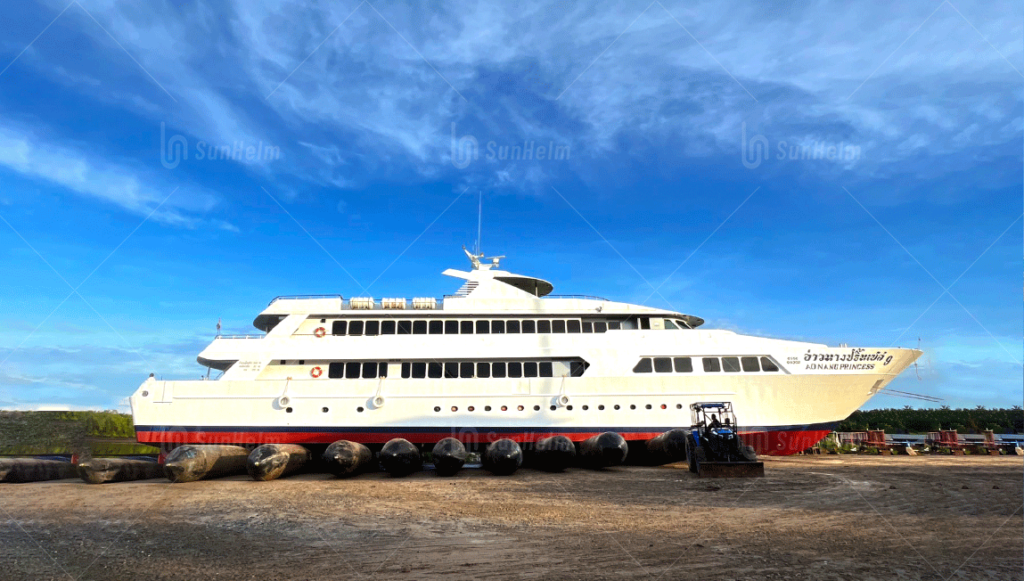
Ship launching is one of the most critical and risky steps in shipbuilding.
No matter how well a ship is designed, a poor launching process can damage the hull, delay delivery, or even cause serious accidents.
Today, many shipyards choose ship launching airbags because they offer better control, lower cost, and higher safety. But airbags alone are not enough. To truly avoid risks, you must understand the ship, the equipment, and the process.
Let’s break it down step by step.
Why Ship Launching Is High Risk
During launching, a ship changes from a static structure on land to a moving object.
At this moment, forces change quickly and mistakes leave little time to react.
Common ship launching risks include:
- Hull damage at the bottom
- Ship sliding sideways
- Loss of control during acceleration
- Airbag failure due to overload or poor quality
The root cause is simple: large weight, complex structure, and uneven forces.
Ship Factors That Affect Launching Safety
Every ship is different, and launching plans should never be copied blindly.
Key ship-related factors include:
- Ship type (cargo ship, barge, fishing vessel, engineering ship)
- Total weight and length
- Hull shape (flat bottom or V-shaped bottom)
- Center of gravity position
Heavier ships or ships with uneven weight distribution need more careful airbag selection and layout.
Why Ship Launching Airbags Reduce Risks
Ship launching airbags work by rolling, not sliding.
This greatly reduces friction and spreads the load evenly across the hull bottom.
Main advantages:
- Smooth and controlled movement
- Even pressure on the hull
- Less damage to ship structure
- Flexible for different ship sizes and yards
- No need for permanent launching tracks
That’s why airbag launching is widely used for small and medium ships, especially in flexible or temporary yards.
Choosing the Right Ship Launching Airbags
Wrong airbags are one of the biggest risk factors.
When selecting airbags, focus on:
- Diameter and length matching ship size
- Load capacity based on ship weight
- Number of rubber layers, matched to real working load
- High abrasion resistance, because airbags roll against the ground
Good airbags do not just carry weight — they must survive repeated rolling without damage.
Proper Airbag Arrangement Matters
Even high-quality airbags can fail if placed incorrectly.
Key layout principles:
- Enough airbags to support the full hull length
- Higher density near bow and stern where stress is higher
- Parallel and aligned placement to avoid side movement
- Stable spacing to keep rolling smooth
A balanced layout keeps the ship straight and stable during launching.
Important Checks Before Launching
Preparation prevents most accidents.
Before launching, always check:
- Ground slope and bearing capacity
- Clean surface with no sharp objects
- Airbag pressure and airtightness
- Contact area between ship bottom and airbags
- Clear launching path and emergency plan
Never rush this step. Most failures happen because of poor preparation.
Risk Control During the Launching Process
Once the ship starts moving, control is everything.
During launching:
- Control the initial rolling speed
- Monitor airbag pressure continuously
- Watch for abnormal movement or tilting
- Keep clear communication among the team
A slow and steady launch is always safer than a fast one.
Safety Checks After Launching
Many people forget this step, but it matters.
After launching:
- Inspect airbags for damage or wear
- Check the ship bottom for marks or deformation
- Record data for future launches
This helps improve safety for the next project.
Conclusion: Safe Ship Launching Is a System, Not Luck
Ship launching risks are not random.
They come from poor planning, wrong equipment, or weak execution.
To avoid risks:
- Understand the ship
- Choose the right ship launching airbags
- Follow a clear and controlled process
With the right approach, ship launching airbags offer a safe, proven, and efficient solution.
FAQ
1. Are ship launching airbags safe for heavy ships?
Yes. When properly selected and arranged, ship launching airbags can safely handle heavy ships within their designed load range.
2. How many ship launching airbags are needed?
The number depends on ship weight, length, and hull shape. More airbags are usually needed near the bow and stern.
3. What is the biggest risk during airbag launching?
Incorrect airbag selection or poor layout is the most common cause of problems.
4. Can ship launching airbags be reused?
Yes. High-quality airbags can be reused many times if properly maintained and inspected.
5. Is airbag launching better than slipway launching?
For many yards, yes. Airbag launching offers more flexibility, lower cost, and less hull stress.