

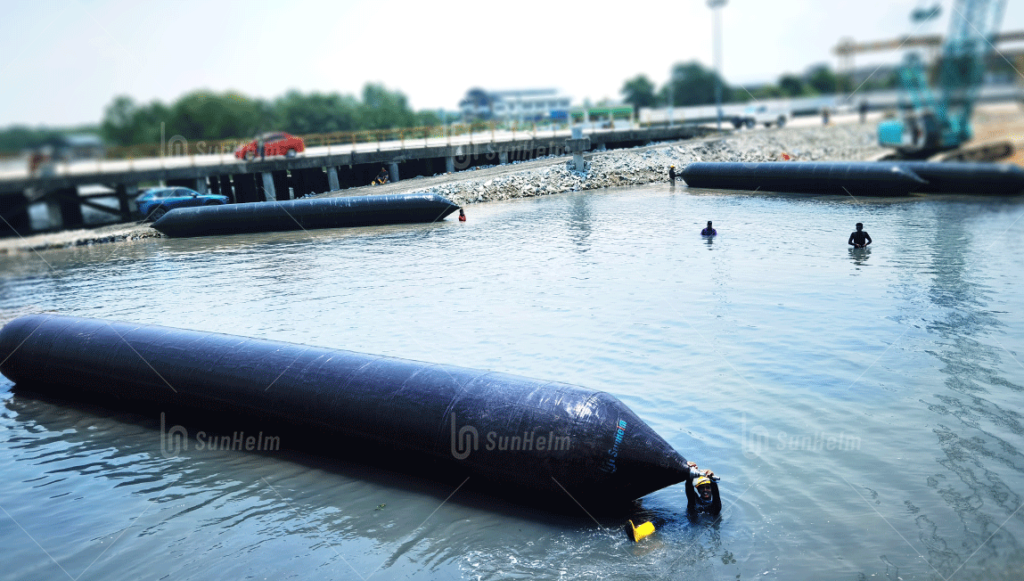
Marine airbags play a critical role in ship launching, vessel hauling, and heavy marine operations. Choosing the right ones is not just a purchasing decision—it directly affects safety, efficiency, and project success. Instead of focusing only on price or size, you need to understand how different factors work together in real operating conditions.
This guide explains how to choose marine airbags step by step, helping shipyards and marine contractors make confident, practical decisions.
1. Start with the Actual Application
Before looking at specifications, clearly define how the airbags will be used.
Marine airbags are commonly applied in:
- Ship launching and landing
- Vessel upgrading or relocation
- Ship repair and hauling operations
- Temporary lifting or support work
Each application places different demands on load capacity, stability, and durability. An airbag suitable for occasional launching may not be ideal for frequent hauling work.
2. Analyze Your Project Conditions
Project conditions determine whether airbags perform safely or fail prematurely.
Key factors to evaluate include:
- Vessel length, width, and total weight
- Launching method (end launching or side launching)
- Slipway slope and ground surface
- Frequency of use
- Ambient temperature and environment
Ignoring these factors often leads to overloading, uneven stress, or excessive wear.
3. Understand Load Capacity and Safety Margin
Load capacity should never be viewed in isolation.
Marine airbags work as a system, not as individual units. The actual working load depends on:
- Number of airbags used
- Spacing and arrangement
- Contact area with the hull
- Rolling resistance during movement
A reasonable safety margin is essential. Choosing airbags that operate close to their limit increases risk, especially during dynamic movement.
4. Select the Correct Size and Quantity
Size selection involves more than choosing the largest diameter available.
Diameter affects:
- Contact pressure on the hull
- Rolling stability
- Load distribution
Length affects:
- Hull support area
- Alignment and balance
Using too few airbags increases stress on each unit, while oversized airbags may reduce control and efficiency. Proper calculation and layout are more important than simply increasing size.
5. Focus on Rubber Quality and Construction
The performance of marine airbags depends heavily on their rubber structure.
High-quality airbags feature:
- Multiple reinforced rubber layers
- Strong internal cord fabric
- High abrasion resistance on the outer layer
- Good elasticity to recover shape after loading
Poor rubber quality leads to cracking, surface damage, and reduced service life—especially in repeated-use projects.
6. Check Manufacturing Standards and Testing
Reliable manufacturers test airbags before delivery, not after failure.
Important checks include:
- Pressure testing
- Load-bearing tests
- Dimensional accuracy
- Visual inspection of rubber layers
Clear technical documentation and test records indicate professional production control and consistency.
7. Consider Durability and Long-Term Cost
The cheapest option often becomes the most expensive over time.
Higher-quality marine airbags:
- Last longer under repeated use
- Require less maintenance
- Reduce downtime and replacement frequency
From a lifecycle perspective, durability has a bigger impact on cost than initial price.
8. Match Airbags to Your Experience Level
For first-time users or complex projects, technical support matters.
Good suppliers can provide:
- Load calculation assistance
- Airbag layout recommendations
- Operating guidelines
- On-site or remote support
This support reduces mistakes and improves operational safety.
9. Avoid Common Purchasing Mistakes
Typical errors include:
- Choosing based only on price
- Ignoring real working conditions
- Underestimating safety margins
- Using one standard size for all projects
Avoiding these mistakes significantly lowers operational risk.
10. Final Checklist Before Purchase
Before placing an order, confirm:
- Application and operating method
- Required size and quantity
- Load calculations and safety margin
- Rubber structure and testing standards
- Warranty and after-sales support
A careful final review prevents costly adjustments later.
Frequently Asked Questions (FAQ)
What are marine airbags mainly used for?
Marine airbags are mainly used for ship launching, vessel hauling, upgrading, and temporary lifting in marine engineering projects.
How do I determine how many marine airbags I need?
The number depends on vessel weight, hull shape, airbag size, spacing, and launching method. Load calculation is essential for safe operation.
Are larger marine airbags always safer?
Not necessarily. Oversized airbags can reduce control and efficiency. Proper size and arrangement are more important than maximum diameter.
How long do marine airbags usually last?
Service life depends on rubber quality, operating conditions, and maintenance. High-quality airbags used correctly can last for many years.
What should I check before using marine airbags?
Always inspect surface condition, air pressure, valve integrity, and layout alignment before operation.