




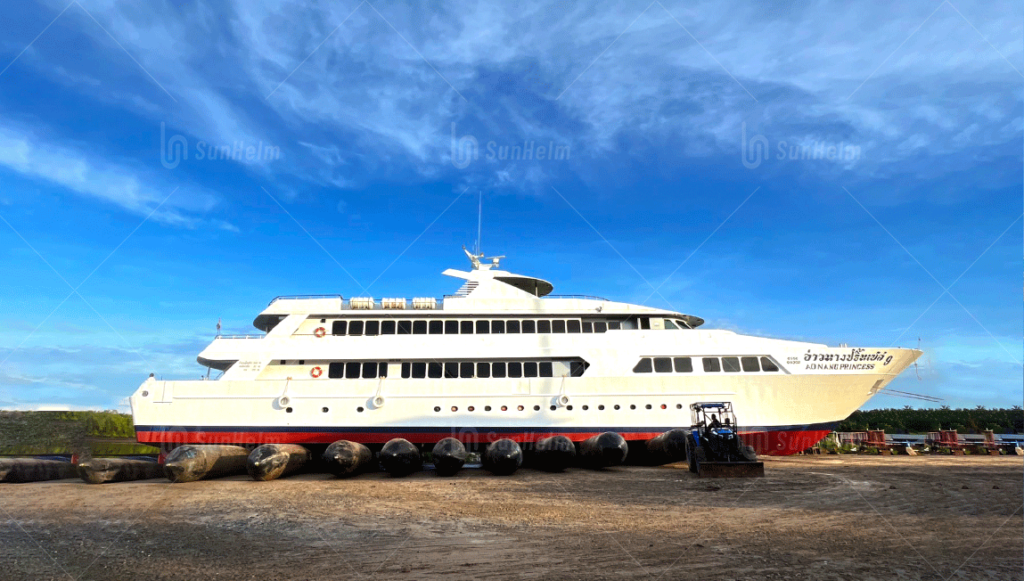
Launching a ship with marine airbags is one of the most flexible and cost-effective methods used by modern shipyards. Ship launching airbags can work on different shorelines, help heavy vessels slide safely, and reduce the need for complex slipways or dry docks.
However, one natural factor always shapes the success of ship launching using airbags: tides.
Tides change the water depth, the flow speed, and sometimes even the ship’s final landing position. Understanding how tides work, how to read tide tables, and how to choose the right launching moment is essential for every shipyard.
This article explains tides in simple language and shows how they influence the entire airbag launching process.
1. What Are Tides and How Do They Work?
Tides are the periodic rise and fall of sea levels caused by the gravitational pull of the moon and the sun. During each tidal cycle:
- When the sea surface reaches the highest level → High tide
- When it drops to the lowest → Low tide
- The rising process → Flood tide
- The falling process → Ebb tide
- The height difference between high and low tide → Tidal range
The time from low tide to high tide is the flood tide duration, and from high tide to low tide is the ebb tide duration.
These changing water levels directly affect the water depth available during a launch, which is why shipyards must treat tides seriously.
2. Main Types of Tides
Tides do not behave the same in all regions. They fall into three main types:
Semi-diurnal tides
- Two high tides and two low tides per solar day
- Tide heights are almost equal
- Common in many places in the Bohai Sea, Yellow Sea, and East China Sea
Diurnal tides
- One high tide and one low tide per day
- Typical in areas like the Beibu Gulf
Mixed tides
- Sometimes two tides per day, sometimes one
- Tide ranges vary greatly
- Common in many southern Chinese ports
On the lunar calendar:
- Around day 1 and 15 → Spring tides (largest tidal range)
- Around day 8 and 23 → Neap tides (smallest tidal range)
These patterns determine how many available “launching windows” a shipyard gets each day.
3. Tide Tables and Why Shipyards Must Use Them
A tide table is a long-term prediction chart that shows expected high tide and low tide times and heights for each day. Tide tables are used in:
- Navigation
- Port construction
- Military operations
- Environmental monitoring
- Shipbuilding and ship launching
Shipyards rely on tide tables to plan the right hour for launching. By checking predicted water levels for the coming year, engineers can design the launching plan early—sometimes months ahead.
This planning is even more important when launching large vessels with ship launching airbags, because the required water depth must match the ship’s draft at the moment it enters the water.
4. How Tides Affect Ship Launching Using Marine Airbags
Tides influence many parts of the launching process:
4.1 Water depth during launching
- High tide provides deeper water, reducing grounding risks.
- Low tide may expose shallow areas or uneven seabeds.
If the water is too shallow, the vessel may stop suddenly, overload the airbags, or damage the keel.
4.2 Launching speed and sliding distance
With more water, the ship floats earlier and slows down smoothly.
With less water, the ship travels farther on airbags before floating, increasing friction and impact forces.
4.3 Horizontal tidal currents
Tides also move water horizontally. Strong currents can:
- Push the vessel sideways
- Cause yawing during entry
- Create uneven pressure on airbags
- Affect the final stopping point
Shipyards must check tide and current predictions together.
4.4 Safety risks
Incorrect tide choices can cause:
- Side-slip or drifting
- Overloaded airbags
- Grounding
- Excessive impact at final float-off
- Damage to shore structures
This is why tide planning is a core part of every airbag launching plan.
5. Using Tide Data in Shipyard and Launching Design
5.1 Slipway and facility design
During shipyard construction, many underwater works are done at low tide to reduce cost and improve visibility.
But the launching water level is determined by analyzing years of tidal data. Engineers calculate the minimum tide height needed to launch safely with marine airbags based on:
- Vessel size
- Launching slope
- Required buoyancy
- Local tidal range
5.2 Planning the launching moment
Shipyards choose a time slot that offers:
- Safe water depth
- Low current speed
- Smooth tidal change
In semi-diurnal tide regions, shipyards often have both a morning and afternoon launching window.
5.3 Tide tables in daily operations
Before launching, engineers check:
- High tide time
- Expected tide height
- Spring or neap tide period
- Horizontal current predictions
Good tide planning reduces risks, saves cost, and improves launching success.
5.4 Inland or non-tidal waters
For rivers or lakes with no tide, designers must rely on multi-year records of flood levels and low-water periods instead of tide tables.
6. Practical Tips for Launching with Marine Airbags Under Tidal Conditions
Here are simple but effective rules:
Tip 1 — Choose stable tide phases
Avoid very fast rising or falling tides. Middle stages are easier to control.
Tip 2 — Check tidal currents, not only tide height
Even if water is deep, strong currents may push the ship sideways.
Tip 3 — Use high tide for large vessels
Bigger ships need more water depth to float safely.
Tip 4 — Inspect seabed conditions during low tide
It helps engineers understand the slipway, underwater slope, and potential grounding points.
Tip 5 — Keep monitoring during the launch
Track the tide height and current every few minutes.
Conditions may change faster than expected.
7. Conclusion
Tides influence every stage of ship launching using airbags—from early slipway design to the exact minute the ship enters the water. By understanding tidal behavior, reading tide tables, and planning around local tidal conditions, shipyards can launch vessels more safely and efficiently.
Marine airbags are flexible and powerful tools, but tides always decide how smooth the final launching moment will be. Good tide planning means a safer launch, lower cost, and a more predictable operation.
FAQ About Marine Fenders
1. What are marine fenders used for?
Marine fenders absorb impact between ships and docks, preventing hull damage and protecting port structures during berthing.
2. What types of marine fenders are most common?
The main types include pneumatic fenders, foam filled fenders, rubber fenders (like cone, arch, and cylindrical types), and floating fenders. Each type serves different berthing needs.
3. How do I choose the right marine fender?
You should consider the vessel size, berthing energy, tidal range, pier structure, and environmental conditions. Larger vessels usually need high-energy fenders like pneumatic or cone rubber fenders.
4. Are pneumatic fenders good for large ships?
Yes. Pneumatic fenders offer high energy absorption and low reaction force, making them ideal for tankers, bulk carriers, and offshore projects.
5. How long do marine fenders last?
High-quality marine fenders can last 8–15 years depending on material, UV exposure, and maintenance. Foam filled fenders often have a longer usable life because they don’t deflate.
6. Can marine fenders float?
Yes. Pneumatic fenders and foam filled fenders are fully floating, which makes them useful in areas with large tidal changes.
7. Do marine fenders require maintenance?
Most types require light maintenance. Pneumatic fenders need regular pressure checks, while rubber fenders mainly need surface inspection and bolt tightening.
{ “@context”: “https://schema.org”, “@type”: “FAQPage”, “mainEntity”: [ { “@type”: “Question”, “name”: “What are marine fenders used for?”, “acceptedAnswer”: { “@type”: “Answer”, “text”: “Marine fenders absorb impact between ships and docks, preventing hull damage and protecting port structures during berthing.” } }, { “@type”: “Question”, “name”: “What types of marine fenders are most common?”, “acceptedAnswer”: { “@type”: “Answer”, “text”: “Common types include pneumatic fenders, foam filled fenders, rubber fenders such as cone, arch, and cylindrical types, and floating fenders.” } }, { “@type”: “Question”, “name”: “How do I choose the right marine fender?”, “acceptedAnswer”: { “@type”: “Answer”, “text”: “Choose based on vessel size, berthing energy, tidal range, pier structure, and environmental conditions. Larger vessels usually need high-energy fenders.” } }, { “@type”: “Question”, “name”: “Are pneumatic fenders good for large ships?”, “acceptedAnswer”: { “@type”: “Answer”, “text”: “Yes. Pneumatic fenders offer high energy absorption and low reaction force, making them ideal for tankers, bulk carriers, and offshore projects.” } }, { “@type”: “Question”, “name”: “How long do marine fenders last?”, “acceptedAnswer”: { “@type”: “Answer”, “text”: “High-quality marine fenders can last 8–15 years depending on material, UV exposure, and maintenance level. Foam filled fenders often last longer because they do not deflate.” } }, { “@type”: “Question”, “name”: “Can marine fenders float?”, “acceptedAnswer”: { “@type”: “Answer”, “text”: “Yes. Pneumatic fenders and foam filled fenders are fully floating, making them suitable for ports with large tidal changes.” } }, { “@type”: “Question”, “name”: “Do marine fenders require maintenance?”, “acceptedAnswer”: { “@type”: “Answer”, “text”: “Most marine fenders require light maintenance. Pneumatic fenders need pressure checks, while rubber fenders need surface inspections and bolt tightening.” } } ] }